
Build Your Best Day: How to Structure Your Virtual School Schedule

Every virtual school family eventually asks the same question: why does the schedule that looked so good on paper fall apart by Wednesday? Usually, it's not a discipline problem — it's a design problem. A schedule built around an idealized student instead of your actual one is set up to fail from day one.
Here's how to build a schedule that fits the family you actually have, notice early when it's not working, and adjust it without turning every afternoon into a negotiation.
Why Schedules Fall Apart at Home
Before building a new schedule, it helps to understand why the last one didn't stick. A few of the most common culprits:
It was built around your ideal day, not your student's real one. A schedule that assumes peak focus for six straight hours rarely survives contact with a kid.
There was no room for the unexpected. One sick day, one bad night of sleep, and the whole week falls apart because there was never any slack built in.
It didn't account for household logistics. Your work calls, a sibling's schedule, or dinner prep all compete for the same hours a "perfect" schedule assumed would be free.
Nobody checked whether it still fit after a few weeks. A schedule built in August rarely still fits once fall sports or new clubs show up in October.
None of these are a failure of willpower, they're just the normal gap between a plan and real life. The fix isn't more discipline. It's a better-designed plan.

Match the Schedule to the Science
Research points to some genuinely helpful windows for different kinds of academic work — and building your student's day around them, rather than an arbitrary block of hours, makes a real difference. According to LSBF, the brain tends to move through a few predictable phases:
Late morning (10 a.m.–2 p.m.): Concentration and retention tend to peak — a strong window for new material or problem-solving.
Afternoon (2 p.m.–5 p.m.): Critical thinking sharpens here, making it well suited to coursework and project work.
Evening/night: Fewer distractions and useful for review — but generally not the best time to introduce something brand new.
Watch your own student for a week before assuming which window fits them best. Some kids are reliably sharper in the morning; others don't really wake up mentally until well after lunch. Build the hardest academic lift around whichever window fits their internal clock.

Build It With Your Student, Not For Them
A schedule your student had a hand in building is far more likely to survive contact with a real week than one handed to them fully finished. Sit down together and cover:
Big vs. small work. Essays, projects, and test prep deserve a dedicated, protected block. Shorter tasks — a worksheet, a quick reading response — can fill the gaps between bigger ones.
A visible due-date system. Without a teacher physically handing back graded work, due dates are easy to lose track of. A shared calendar or a whiteboard both of you can see prevents last-minute scrambles.
Real breaks, not just gaps. Northwestern Medicine notes that a healthy routine doesn't need to be complicated — regular movement, a bit of morning sunlight, and a consistent wind-down in the evening go a long way. Even a five-minute break has measurable value for resetting focus.
This kind of structured sorting is especially useful for students who process big, vague tasks differently — including students with ADHD, who often do best when a large assignment is broken into small, concrete steps rather than one undefined block of "homework."
What This Looks Like at Each Age
The same core principles — energy windows, right-sized work, real breaks — show up differently depending on your student's age.
Elementary school:
Shorter blocks (20–30 minutes), with movement breaks woven in
Live sessions clustered earlier in the day, when focus tends to be highest
A visual, picture-based schedule rather than a text-heavy one
Middle school:
Slightly longer blocks (30–45 minutes)
Growing independence in managing their own checklist, with a parent check-in once or twice a day
Deliberate room for extracurriculars or social time — not squeezed in as an afterthought
High school:
Full 45–60 minute blocks aligned to their real energy windows
A lighter parental check-in role, with more ownership shifting to the student
Protected sleep time — high schoolers are especially prone to sacrificing it under deadline pressure, and it backfires every time
Signs the Schedule Isn't Working
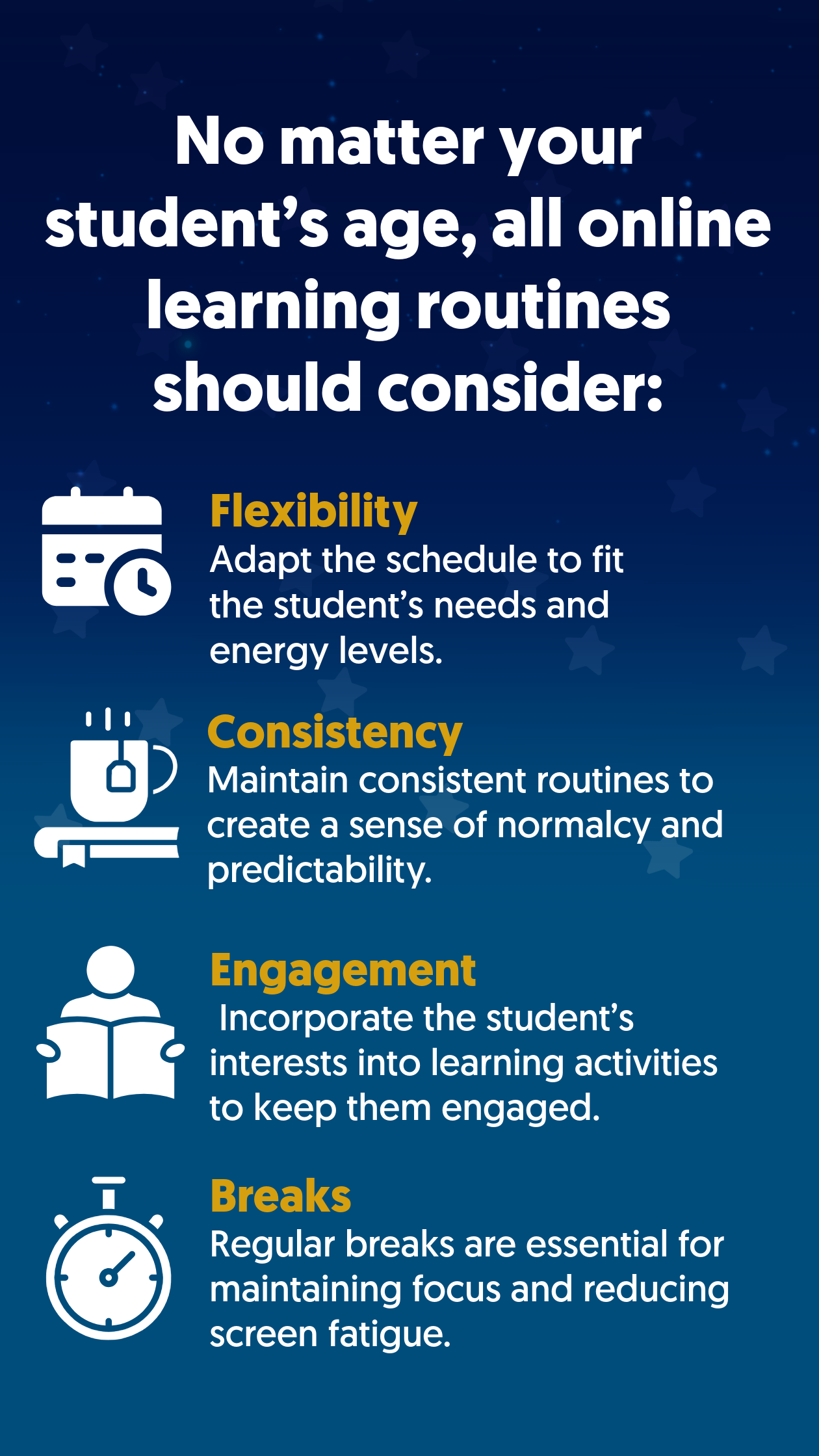
A schedule that's quietly failing doesn't always announce itself. A few signs worth watching for:
Assignments consistently start the night before they're due, regardless of when they were assigned
Your student seems more irritable or anxious around schoolwork than the material alone would explain
Sleep keeps getting pushed later to "catch up" on work that didn't get done during the day
The schedule gets ignored more days than it gets followed
Any one of these is a signal to revisit the plan, not evidence that your student isn't trying hard enough.
Adjusting Without a Power Struggle
Schedule conversations can turn into arguments fast, especially with a student who already feels behind. A few things that help keep it collaborative:
Frame it as troubleshooting, not correction. "This part of the day isn't working — let's figure out why" lands very differently than "you're not following your schedule."
Ask before you propose. "What part of the day feels hardest right now?" often surfaces the real issue faster than guessing.
Change one thing at a time. Overhauling the whole schedule at once makes it hard to tell what actually fixed the problem.
Revisit on a set rhythm, like every two weeks, so adjustments feel like routine maintenance rather than a response to a blow-up.
Coordinating Your Own Day Around Theirs
For most families, a student's schedule doesn't exist in isolation — it has to coexist with work calls, siblings, and the rest of household life. A few things that help:
Anchor your student's most independent work block to your own busiest window, so you're not needed for hands-on help at the exact moment you can't give it
Use a shared family calendar so everyone can see, at a glance, when a student has a live session that shouldn't be interrupted
Build in one buffer block in your day too — the unexpected doesn't only happen to students
Frequently Asked Questions
What if my student's best focus time doesn't match the live lesson schedule?
Live lessons are usually fixed, independent work is not. Anchor the day to live sessions, then place the hardest independent work in your student's genuine energy window.
How long should a break actually be?
Five minutes is enough to be worth it. Between major work blocks, 15 to 20 minutes works better, especially around the midday slump.
Should weekends follow the same structure?
Not exactly, but holding wake and sleep times reasonably consistent across the weekend makes Monday morning much easier.
It's too hot to go outside for most of the fall. What counts as a break?
Anything that gets your student away from the screen. Stretching indoors, a snack at the kitchen table instead of the desk, or a few minutes of quiet all do the job. The screen break is what matters, not the fresh air.
The Bottom Line
A schedule isn't something you hand your student once and hope holds. It's a living system you build together, watch for warning signs in, and adjust without turning it into a fight. Get that part right, and the rest of the school year gets noticeably calmer.
And you don’t have to navigate your schedule all alone! At Texas Virtual Schools, our teachers are always happy to meet with families and tackle issues together.
Ready to build a school day that actually works for your family? Enroll Today
Questions? Our enrollment specialists are happy to help: Call Today!
Follow us for more Learning Coach tips all year: Facebook | Instagram | TikTok

Sources
LSBF, What Is the Best Time for Studying — Day or Night? lsbf.edu.sg
Northwestern Medicine, Healthy Habits to Strengthen Your Daily Routine. nm.org
ASU Prep Digital, Online Learning Routine. asuprepdigital.org